


This difference can cause a capacitor bank that was working correctly before the photovoltaic generation was installed to stop providing adequate compensation. The result can be unstable readings, discrepancies between the controller and the billing meter and, ultimately, new penalties for reactive energy consumption.
To avoid penalties, it is normally necessary to maintain a power factor of 0.95 or higher. A cos φ of 0.95 allows approximately 33 % reactive energy to be consumed relative to active energy without exceeding the penalty limit:
| Active energy drawn from the grid | Approximate reactive energy without penalty |
| 100 kWh | Up to 33 kvarh |
| 50 kWh | Up to 16,5 kvarh |
| 10 kWh | Up to 3,3 kvarh |
Before installing self-consumption, an installation consuming 100 kWh may have a margin of approximately 33 kvarh. If photovoltaic generation reduces grid consumption to just 10 kWh, the margin is reduced to approximately 3.3 kvarh.
Loads continue to require reactive energy, but the permissible amount decreases as the active energy recorded by the meter falls. When photovoltaic generation approaches total consumption, any small deviation can result in a penalty. Conventional capacitor banks operate using fixed-power steps and may have difficulty making a sufficiently precise adjustment when the available margin is very small.
Compensation performance also depends on the self-consumption connection point and where the measurement is taken. Let’s look at the main scenarios.
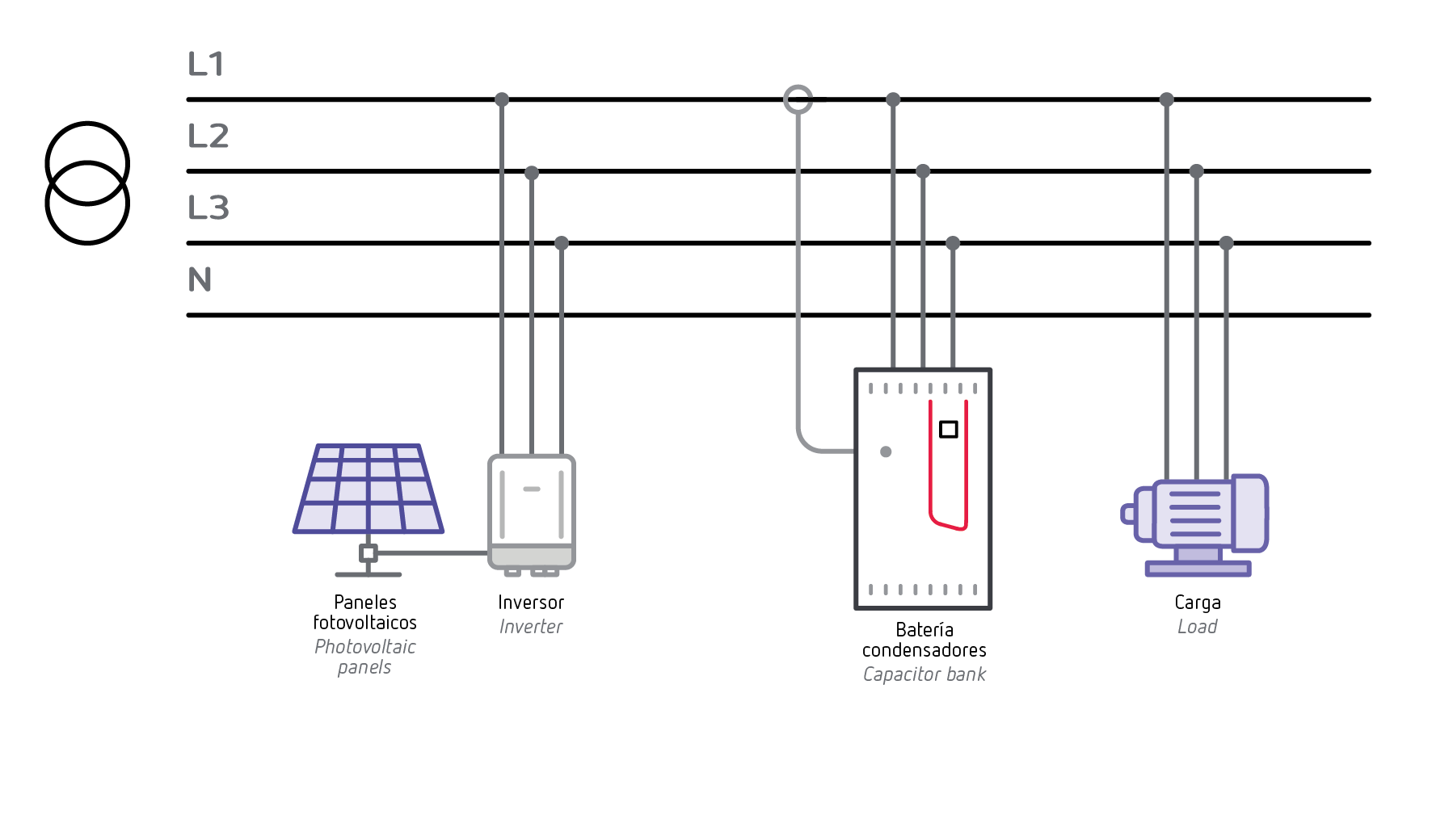
In this configuration, the capacitor bank controller measures the total load consumption and considers the installation to be correctly compensated. However, thanks to photovoltaic generation, the billing meter records a much lower demand for active energy from the grid. The controller may show a good power factor, while the meter detects different conditions.
The bank compensates correctly based on the information it receives, but the electricity company’s meter may continue to record penalties.
| Parameter | Without photovoltaics | With PV at the point of connection |
| Total load consumption | 100 kWh | 100 kWh |
| Photovoltaic generation | 0 kWh | 90 kWh |
| Active energy drawn from the grid | 100 kWh | 10 kWh |
| Load reactive energy | 80 kvarh L | 80 kvarh L |
| Capacitor bank compensation | 70 kvarh C | 70 kvarh C |
| Reactive energy recorded from the grid | 10 kvarh L | 10 kvarh L |
| Cos φ displayed by the controller | 0,99 | 0,99 |
| Cos φ recorded by the meter | 0,99 | 0,71 aprox. |
| Result | No penalty | PENALTY |
Without photovoltaic generation, the residual 10 kvarh is compared with 100 kWh, so the installation remains within the permitted margin. With self-consumption, the same 10 kvarh is compared with only 10 kWh consumed from the grid. Although the capacitor bank operates in the same way, the ratio between active and reactive energy changes completely.
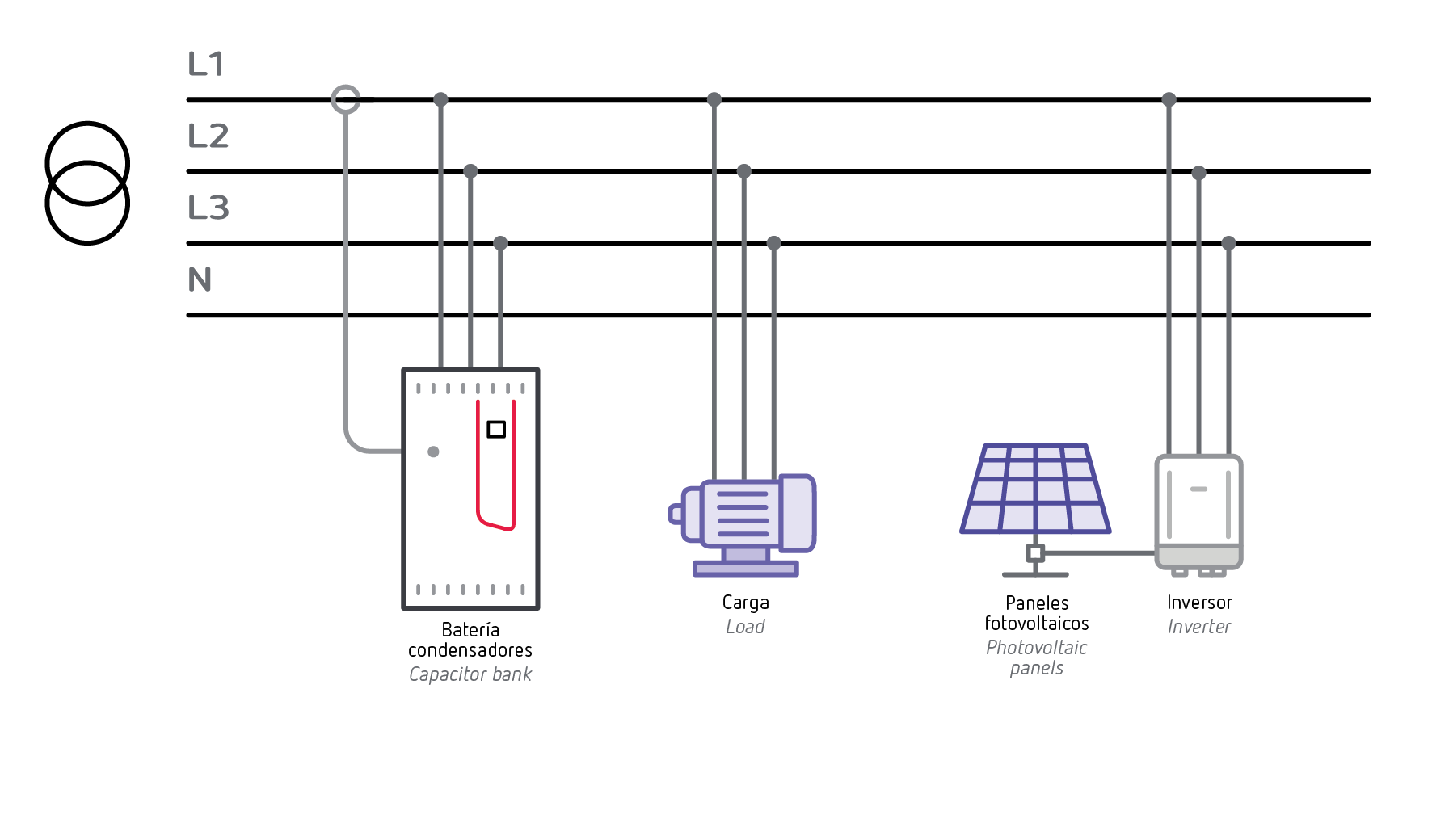
In this configuration, the current transformer associated with the controller measures only the energy drawn from the grid, after subtracting the photovoltaic contribution. When self-consumption covers a significant part of the demand, the current flowing through this transformer may be insufficient to ensure the correct operation of the capacitor bank.
| Parameter | Without photovoltaics | With PV in parallel |
| Total load consumption | 100 kWh | 100 kWh |
| Photovoltaic generation | 0 kWh | 90 kWh |
| Active energy drawn from the grid | 100 kWh | 10 kWh |
| Load reactive energy | 80 kvarh L | 80 kvarh L |
| Capacitor bank compensation | 70 kvarh C | 0 kvarh if it does not operate |
| Reactive energy recorded by the grid | 10 kvarh L | 80 kvarh L |
| Power factor recorded by the meter | 0,99 | 0,12 aprox. |
| Result | No penalty | HIGH PENALTY |
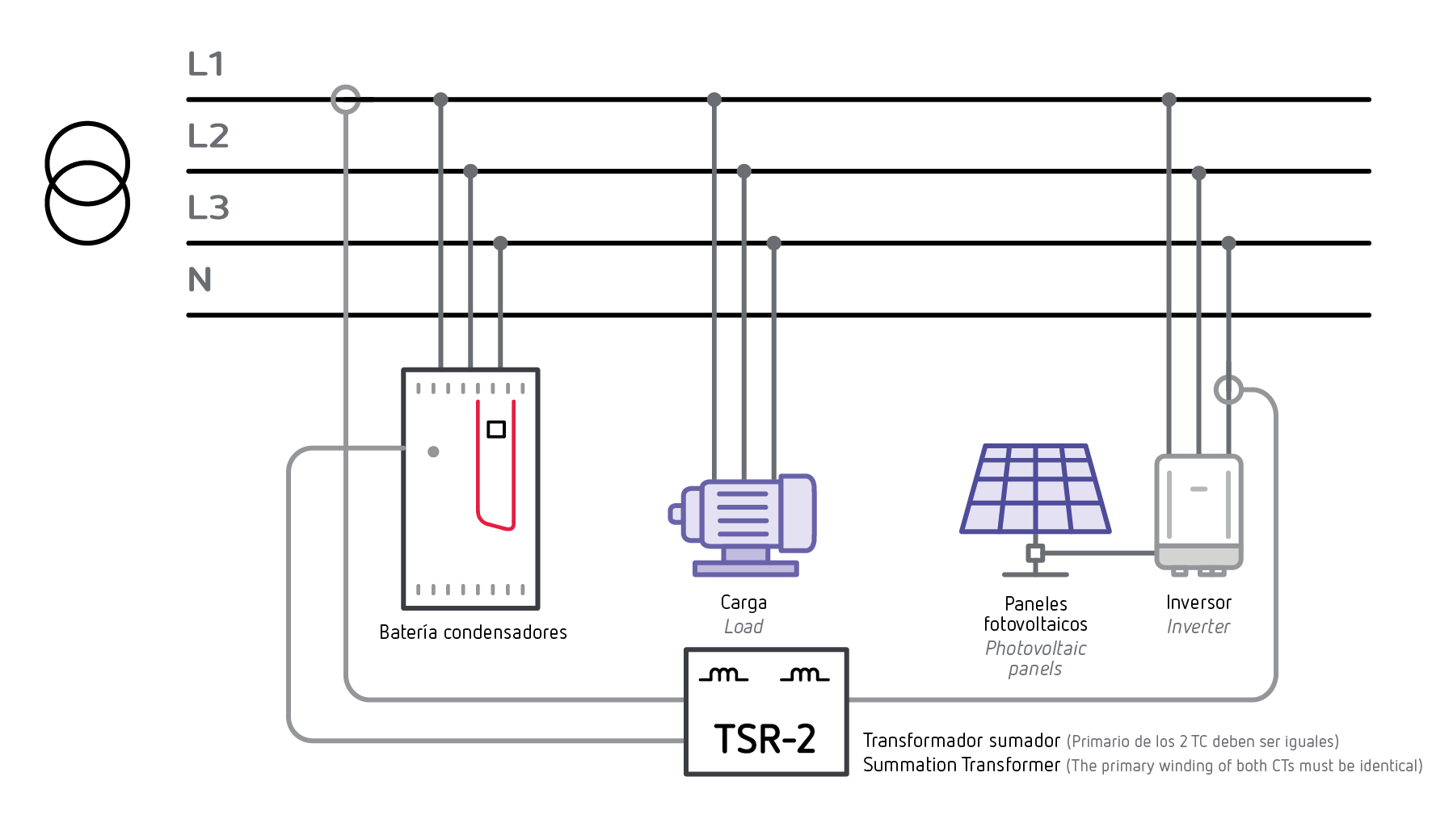
One way to improve measurement is to install additional current transformers and a current adding transformer. This allows the controller to take into account both the current drawn from the grid and the current supplied by the photovoltaic generation system, restoring the measurement of the total load consumption.
However, converting the measurement to a configuration equivalent to self-consumption at the point of connection does not necessarily eliminate the differences between the power factor interpreted by the capacitor bank and the one recorded by the meter.
Therefore, this solution improves the controller’s measurement capability, but on its own it does not ensure sufficiently accurate compensation to avoid penalties under all generation and consumption conditions.
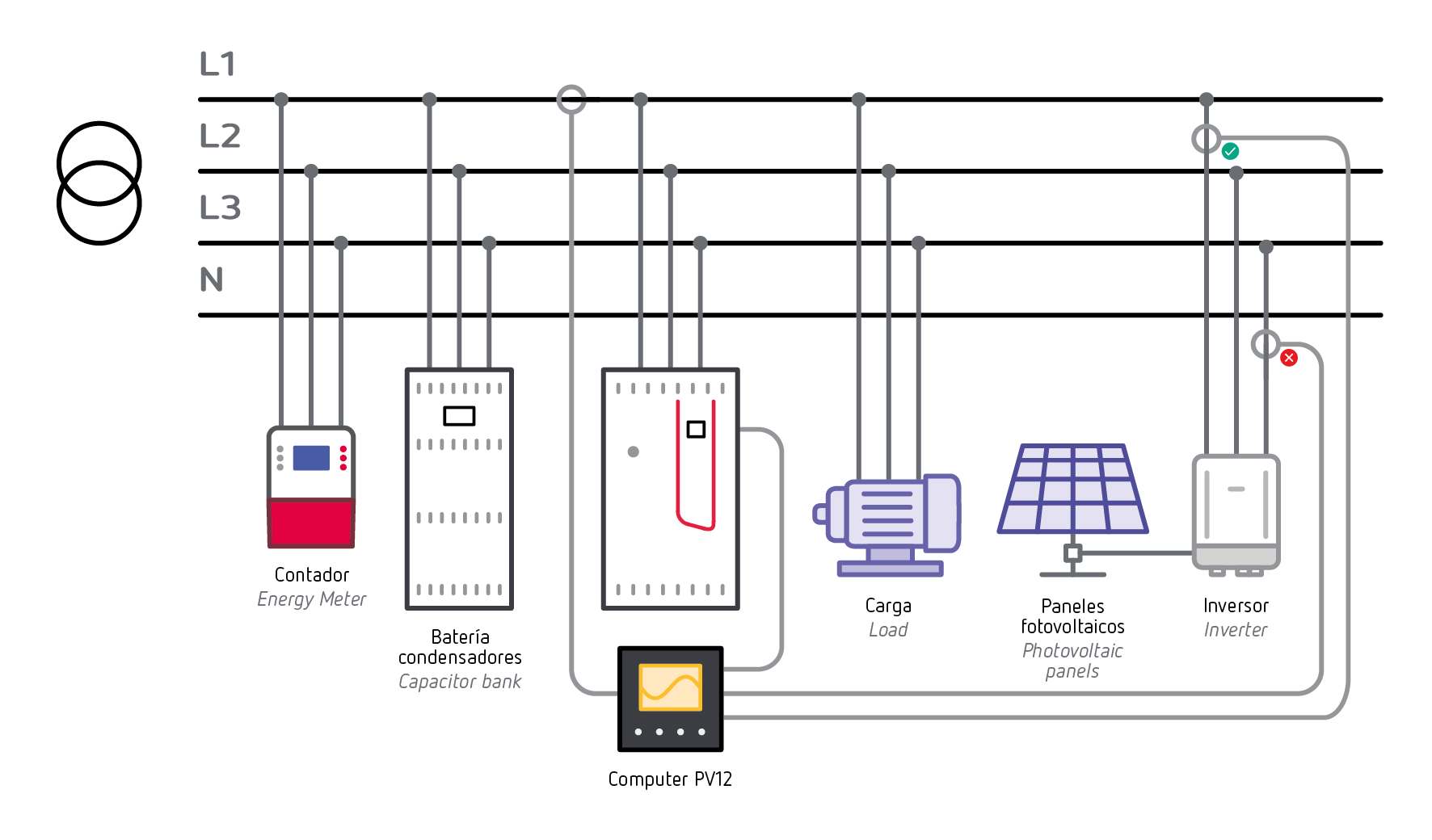
Computer PV12 is designed to manage reactive power compensation in self-consumption installations without the need for an external current adding transformer. The device receives the signals corresponding to the installation and the photovoltaic generation system, simplifying measurement and reducing the number of auxiliary devices, wiring complexity, potential installation errors and commissioning time.
Computer PV12 can be configured with any primary ratio of the current transformers used. This makes it easier to adapt to existing installations without requiring the use of transformers with identical ratios.
However, compensation is still carried out using a capacitor bank with fixed steps. Therefore, the final accuracy still depends on the power of the smallest step, the capacitor bank configuration, switching speed, and variations in generation and consumption.
Conventional solutions can address specific situations. However, each installation requires a preliminary assessment of the photovoltaic generation connection point, the billing meter location, the controller measurement point, the current transformer ratio, the capacitor bank power and number of steps, expected generation and load variability.
A photovoltaic installation never operates under completely stable conditions. Generation can change rapidly due to cloud cover, time of day or environmental conditions. Likewise, the connected loads also vary throughout the day. A solution that is suitable at a given moment may no longer perform in the same way when the balance between generation and consumption changes.
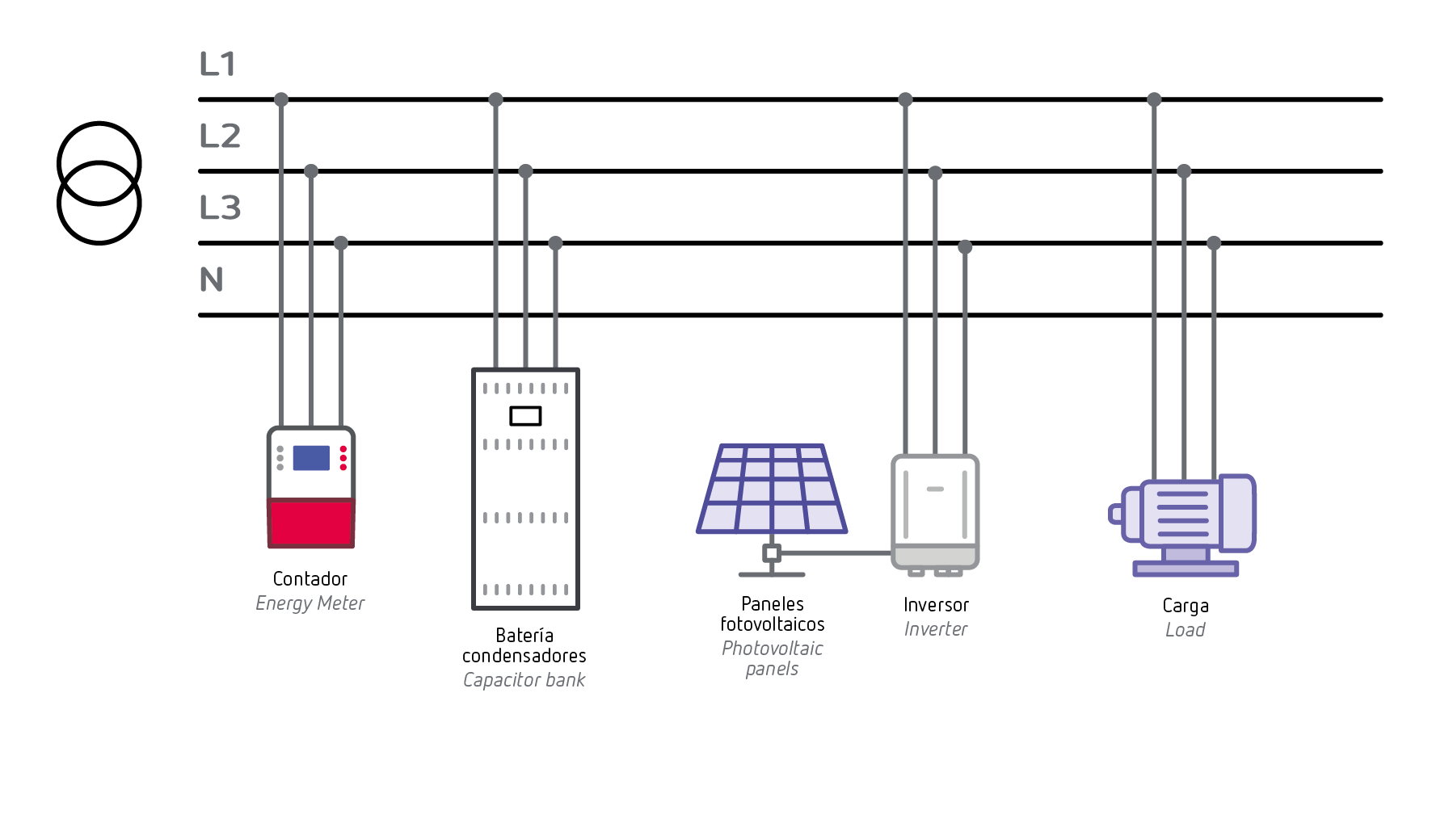
Self-consumption at the supply connection
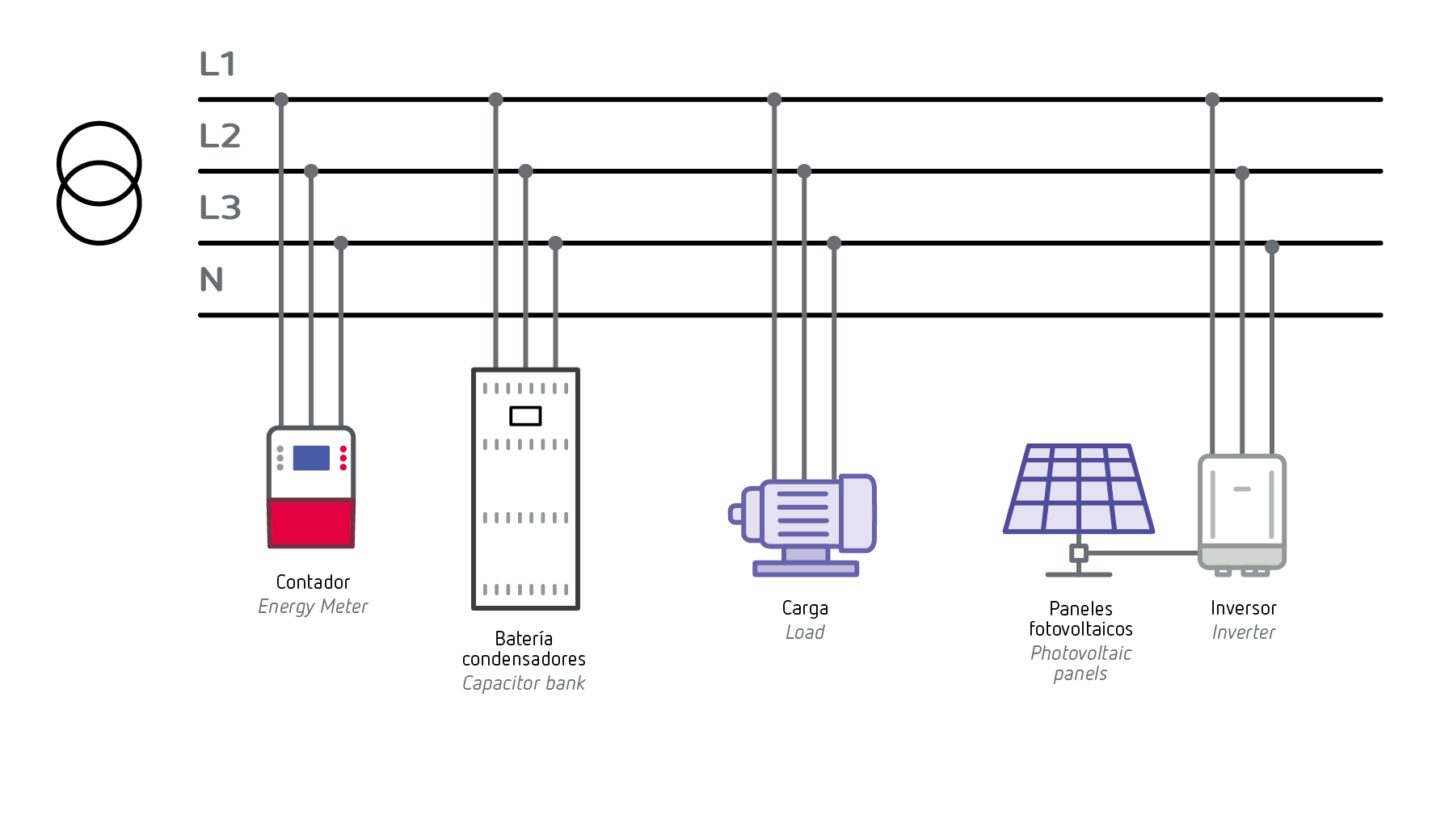
Parallel self-consumption
The static var generator SVGm from CIRCUTOR electronically adjusts compensation according to the installation’s actual needs. Unlike a conventional capacitor bank, SVGm does not rely on a limited combination of steps. Compensation is dynamic, accurate and virtually instantaneous, even when photovoltaic generation or consumption changes continuously.
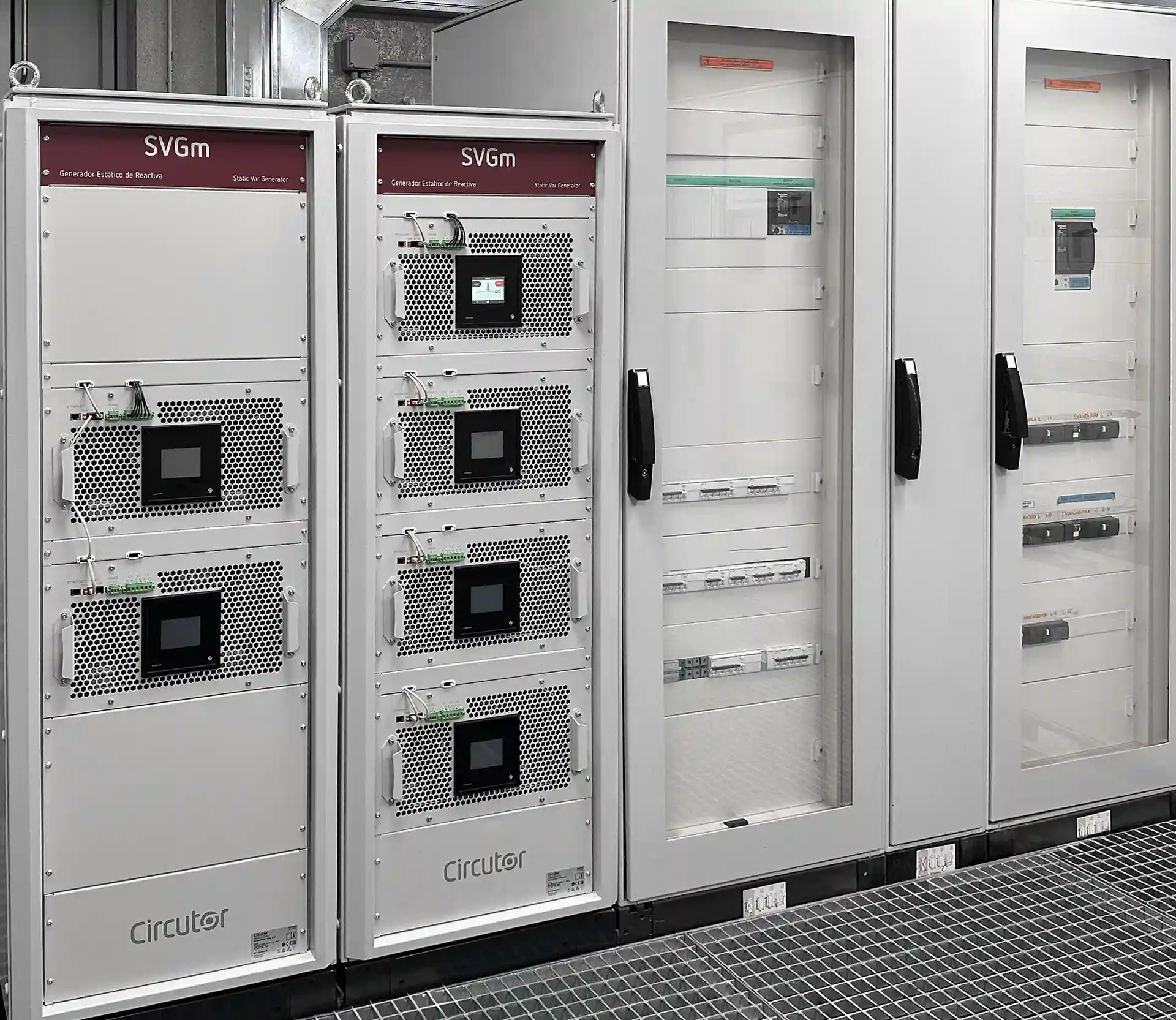
Each photovoltaic installation may have a different configuration. Conventional solutions can correct some problems, but may also require new transformers, additional wiring, specific controllers or modifications to the capacitor bank. Even after these adaptations, compensation still depends on fixed-power steps.
SVGm simplifies the whole process with a single technology that can:
SVGm ensures accurate compensation and helps avoid reactive energy penalties in self-consumption systems, regardless of the installation’s configuration and variations.

WRITTEN BY CIRCUTOR
Vial Sant Jordi s/n – 08232
Viladecavalls, Barcelona (Spain)
+34 93 745 29 00
Contact
After-Sales and Technical Assistance
+34 93 745 29 19
Send enquiry

© 2026 CIRCUTOR.COM | All rights reserved.