RGU-110B: la evolución de la selectividad de tipo para asegurar la continuidad de servicio

RGU-110B: the evolution of type selectivity to ensure continuity of service

Circutor | 18 de May de 2026

Service continuity and safety depend largely on the correct coordination between protection devices. Type selectivity ensures that, in the event of an overvoltage or short-circuit, only the device closest to the fault will act, minimising the impact on the rest of the installation. It is a key concept in industrial and tertiary environments where energy availability is critical.

In a chain of protections, downstream devices must act before those located upstream. In type selectivity, this hierarchy depends not only on parametric settings, but also on the physical interaction between devices designed to work together.

Differences with other types of selectivity

  • Amperometric selectivity: It is based exclusively on the difference in nominal ratings.
  • Chronological selectivity: It introduces intentional delays in upstream devices to allow the downstream device to operate. It requires precise time coordination.
  • Type selectivity: It is based on certified compatibility between specific devices, regardless of purely electrical settings, offering greater robustness against high-energy failures.

Exceeding market limitations up to 4000 A

Until now, installations could not follow the type coordination: although they installed type-B protection for the variable frequency drives in their installation, in the mains panel of that same installation of over 1000 A, there were no type-B solutions on the market that could cover that current level, and they ended up installing type-A residual current protection solutions, which were the protection available on the market.

Thanks to the new RGU-110B and WB transformers, we can now properly coordinate the installation, achieving a safe installation and maximising its continuity of service by avoiding costly nuisance trips.

The RGU-110B series features transformers to protect loads up to 4000 A, allowing proper type coordination in sub-panels or main panels, and the protection of large loads such as variable speed drives.
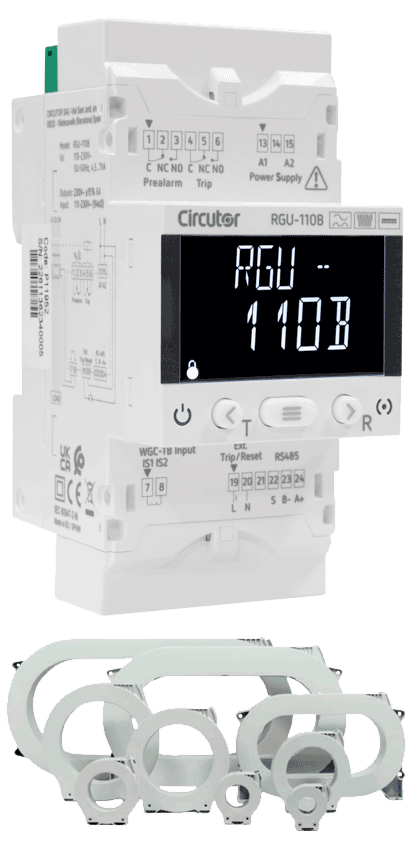
RGU-110B + WB

Advanced protection for critical industrial environments

The RGU-110B is a Type B residual current protection electronic relay designed to detect and manage leakage currents in modern electrical installations. This device is capable of measuring not only alternating current leakage, but also direct current leakage and mixed signals, making it especially suitable for environments where power electronics are used.

Together with the WB transformers, it protects and monitors all electrical installations where, due to the type of load, the applicable law or manufacturer's requirement, it is necessary to install type-B earth leakage protection. Its main function is to continuously monitor the insulation status of the installation and activate a trip signal when the set threshold is exceeded, thus helping to keep people and equipment safe.
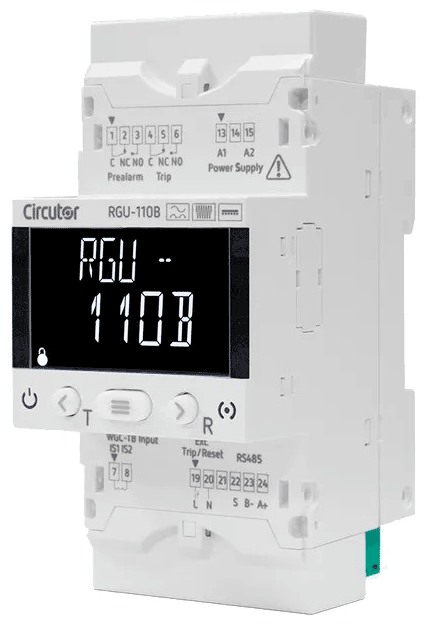
RGU-110

Preventive maintenance and total control

The RGU-110B is designed to provide peace of mind to the maintenance manager:

  • Prealarm and anticipation: It features a display and relay prealarm. Before an event is triggered, the device allows preventive maintenance to be scheduled when the installation is taken offline
  • Diagnosis and logging: It offers an event log that can be analysed to aid in technical troubleshooting
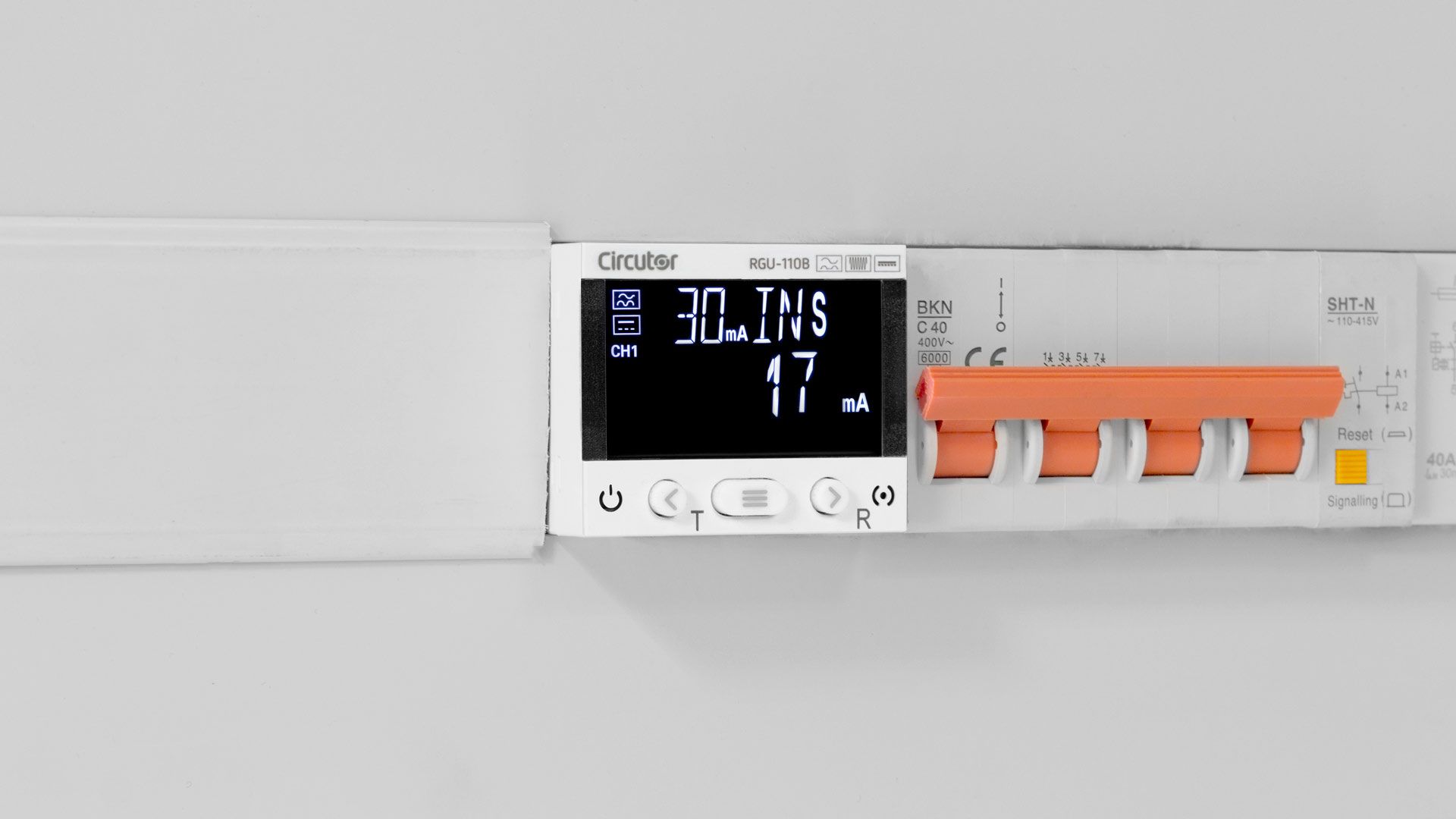
  • Quick visual identification: The display is backlit in red when it trips, making it easier to identify the line containing the fault
  • Operational modes: The operational mode of the device at any given moment is easily identifiable thanks to the backlighting on the display

FAQs

  1. What is type selectivity and why is it vital for my plant?
    Type selectivity
    ensures that, in the event of a fault, only the protection device closest to the fault will activate. Unlike amperometric or chronological selectivity, this is based on certified physical compatibility between devices, which prevents a problem in a secondary line from tripping the mains panel and stopping all production.
  2. Can I protect high-power loads with the RGU-110B?
    Yes. The RGU-110B, in combination with the WB series transformers, allows protecting and monitoring installations with currents up to 4000 A. This solves the historical market failure, where there were no type-B protections for high-power mains panels, forcing the use of less suitable type-A protections.
  3. How does this device help with preventive maintenance?
    The device has a configurable prealarm system via display and relay. As a result, the maintenance manager will receive a warning before the trip threshold is reached, giving them time to act and avoid an unscheduled stoppage.
  4. What type of leaks is it capable of detecting?
    As it is a class B relay, it has been designed to manage modern installations with power electronics, such as variable speed drives. It detects leaks in alternating current (AC), direct current (DC) and mixed signals, complying with the most demanding safety and power quality regulations.
  5. Is it difficult to identify which line has failed in a complex industrial environment?
    No. The RGU-110B facilitates rapid identification through its backlight display. In the event of a tripping, the screen automatically changes to red, allowing the operator to visually locate the line with the fault instantly, reducing the mean time to repair (MTTR).
  6. Can it be integrated with my current SCADA system?
    Circutor devices are designed to be compatible with industrial management systems such as SCADA, BMS or OPC via Modbus/TCP/IP connectivity. This provides complete visibility of consumption and events in real time from the control centre.

WRITTEN BY CIRCUTOR

SHARE THIS ARTICLE

NEWSLETTER