


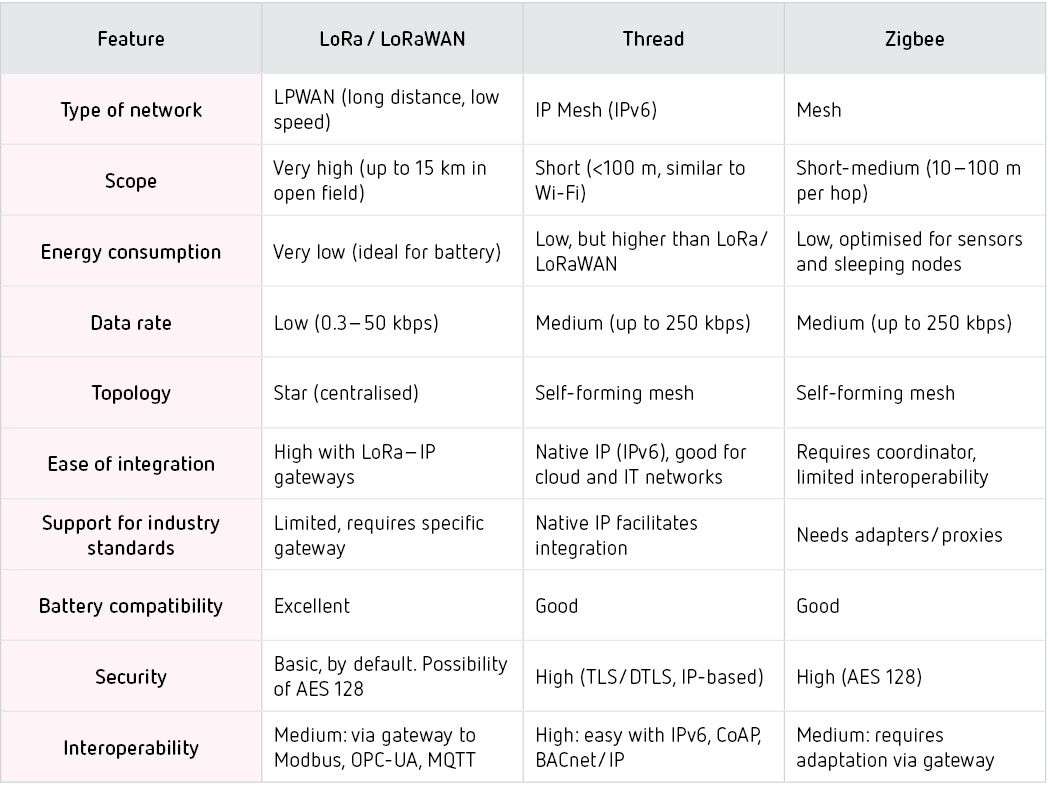
Wireless communication networks are an essential component in many industrial IoT and automation solutions. Protocols such as LoRa™ Private (P2P) / LoRaWAN, Thread, and Zigbee are among the most widely used wireless technologies in sensor networks, building automation, and Industry 4.0.
Their choice directly affects key aspects such as energy consumption, interoperability, installation and maintenance costs, and the scalability of each project.
LPWAN (Low Power Wide Area Network) technology, ideal for long distances and low power consumption. It operates in unlicensed sub-GHz bands and is widely used in monitoring applications in both industrial environments and smart buildings.
An IPv6-based protocol designed for secure mesh networks with native IP connectivity. Commonly used in home automation and smart building automation, where integration with IT networks is a priority.
A mesh network optimised for low power consumption and localised applications. It is a well-established standard in home automation and basic automation, with a widely available ecosystem of devices.
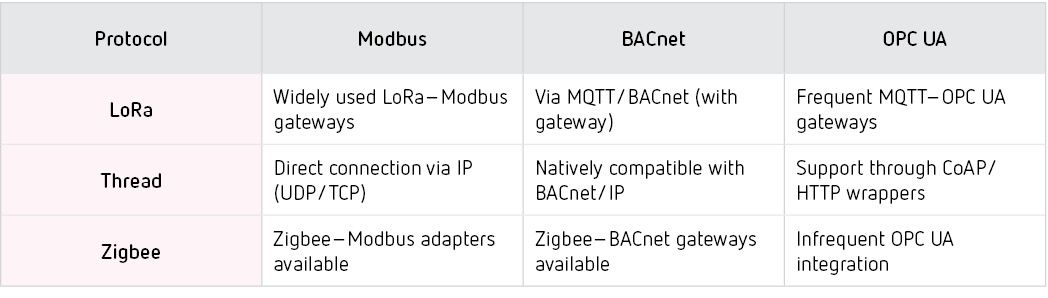
One of the main challenges of industrial IoT is integration with traditional industrial protocols, such as Modbus, BACnet, and OPC UA. Each wireless technology offers different forms of communication with these systems:

Ideal for industrial, rural, or distributed areas that require long range and low energy consumption. It is the best option for environmental monitoring, energy projects, or sensor deployments in locations where wired infrastructure is limited.
However, it is not suitable for real-time control due to its low speed and higher latency.

Perfect for smart buildings, advanced home automation, and converged IT/OT networks. Its native IP compatibility and self-forming mesh topology make it a flexible and scalable solution for integration with cloud platforms or centralised management systems.

Widely used in residential home automation and small local installations, with low power consumption and a mature standard. It offers reliability and ease of implementation, although its range and flexibility are lower compared to Thread.
LoRa™ Private P2P networks have established themselves as a robust and cost-effective solution to extend the coverage of sensors and devices in IoT monitoring and automation projects.
They allow wired Modbus RTU installations to be extended wirelessly, reduce cabling costs, speed up installation and maintenance, and maintain the reliability typical of an industrial network.
Combining LoRa™ Private P2P with Modbus RTU provides solid connectivity for projects that require long range, simple installation, and independence from public networks or licensing.
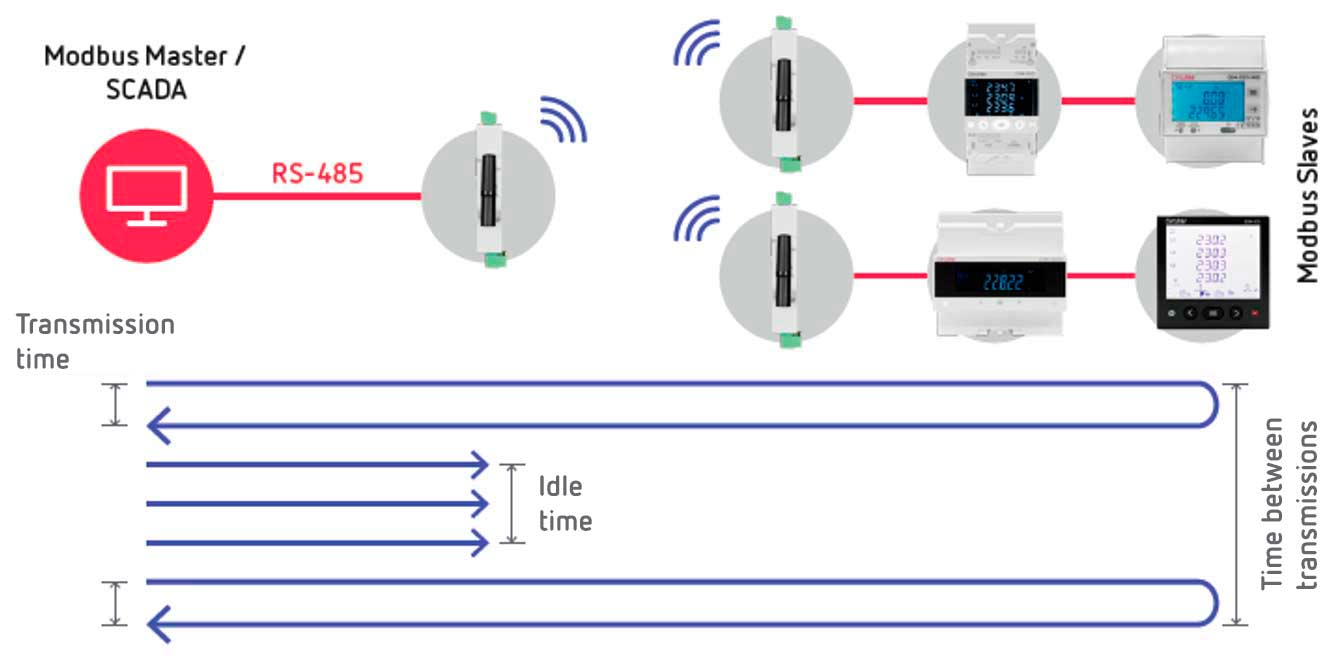
If your project requires a wireless solution for industrial monitoring, Circutor offers LoRa™ Private P2P to Modbus RTU converters, such as the Bridge LR PSAC or Bridge LR PSDC models, designed to easily integrate sensors and devices distributed across secure and efficient industrial networks.

WRITTEN BY CIRCUTOR
Vial Sant Jordi s/n – 08232
Viladecavalls, Barcelona (Spain)
+34 93 745 29 00
Contact
After-Sales and Technical Assistance
+34 93 745 29 19
Send enquiry

© 2024 CIRCUTOR.COM | All rights reserved.