

Circutor | 18 June 2026
This change can cause the capacitor banks that previously correctly avoided reactive energy penalties to stop regulating with the same precision. Consequently, following the connection of a photovoltaic self-consumption system, new reactive energy penalties may appear that did not previously exist.
The main reason is that self-consumption reduces the active energy taken from the grid, but it does not always reduce the reactive energy required by the installation in the same proportion. This alters the power factor reading and can create imbalances between the capacitor bank, the reactive energy regulator and the utility's meter.
For this reason, installations with self-consumption require compensation systems capable of adapting to a more dynamic energy scenario, where different energy sources coexist and electrical flows change throughout the day.
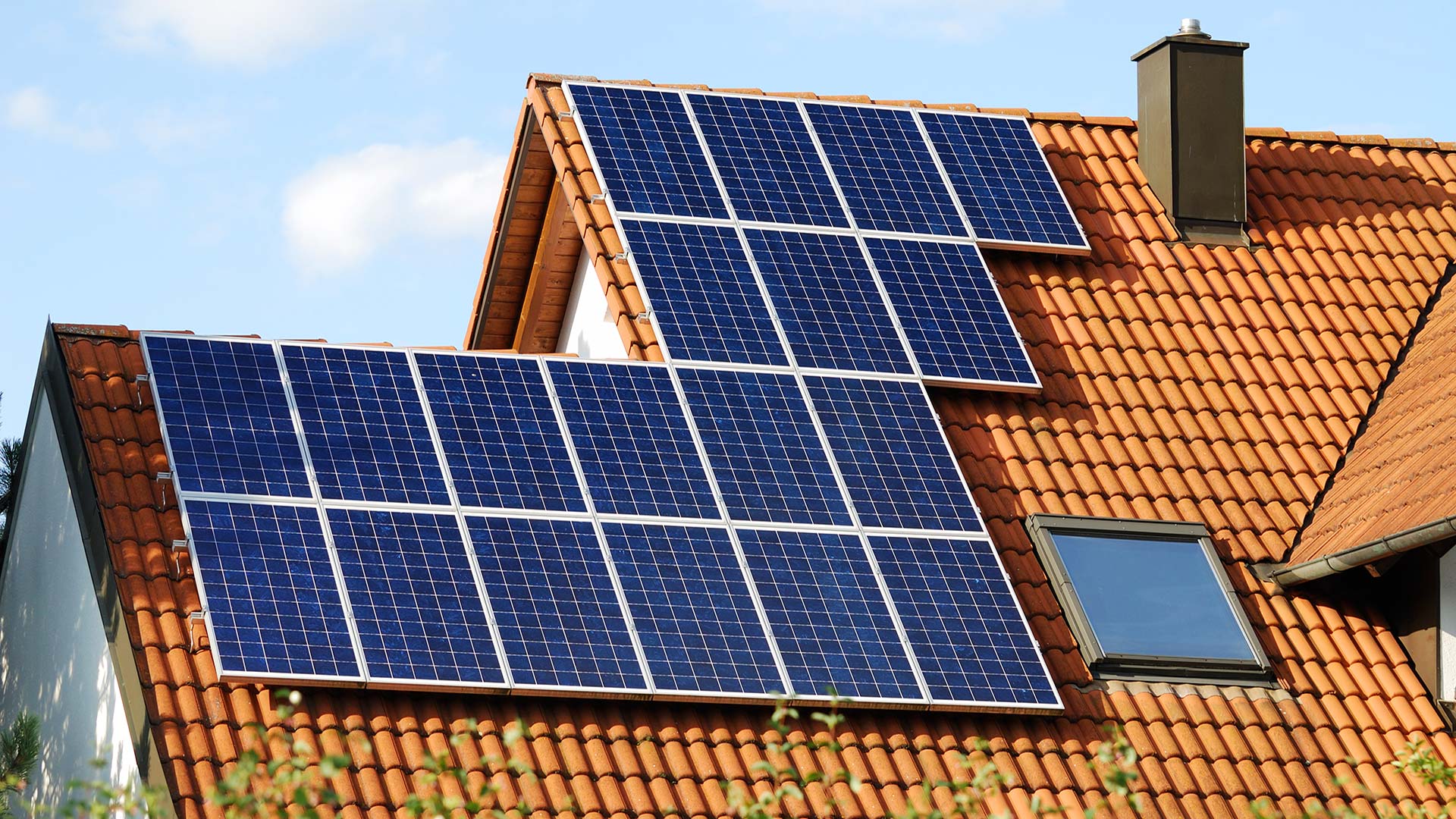
In an installation without self-consumption, the capacitor bank compensates for reactive energy by taking the electricity consumption from the grid as a reference. However, when a photovoltaic installation is incorporated, part of the active energy consumed by the installation no longer comes from the grid and is instead generated locally.
This might seem positive, and it is from an energy-saving point of view. But from the perspective of power factor correction in photovoltaic self-consumption, the situation becomes more complex.
The installation can continue to demand inductive reactive energy, even though active energy consumption from the grid has been reduced. As a consequence, the cos φ measured by the system may no longer correctly reflect the true behaviour of the installation.
When this happens, the capacitor bank may regulate inadequately, generating compensation errors, overcompensations or penalisable values on the electricity bill.
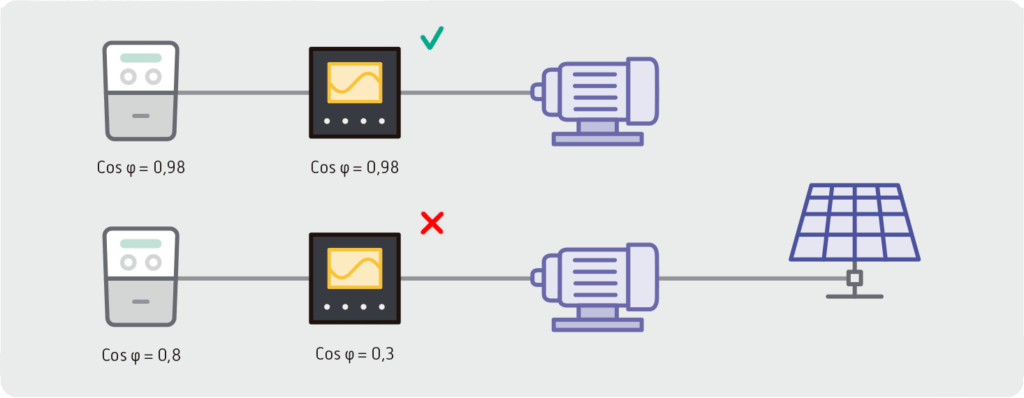
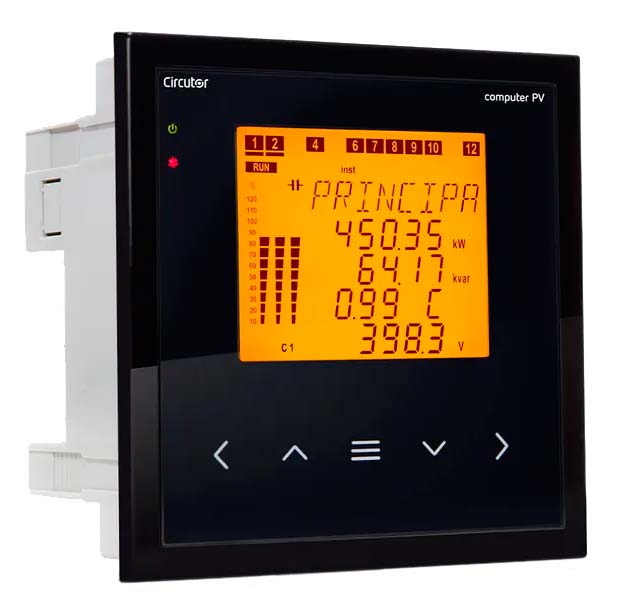
To optimise power factor correction in installations with photovoltaic self-consumption, Circutor is launching the new Computer PV 12 regulator onto the market.
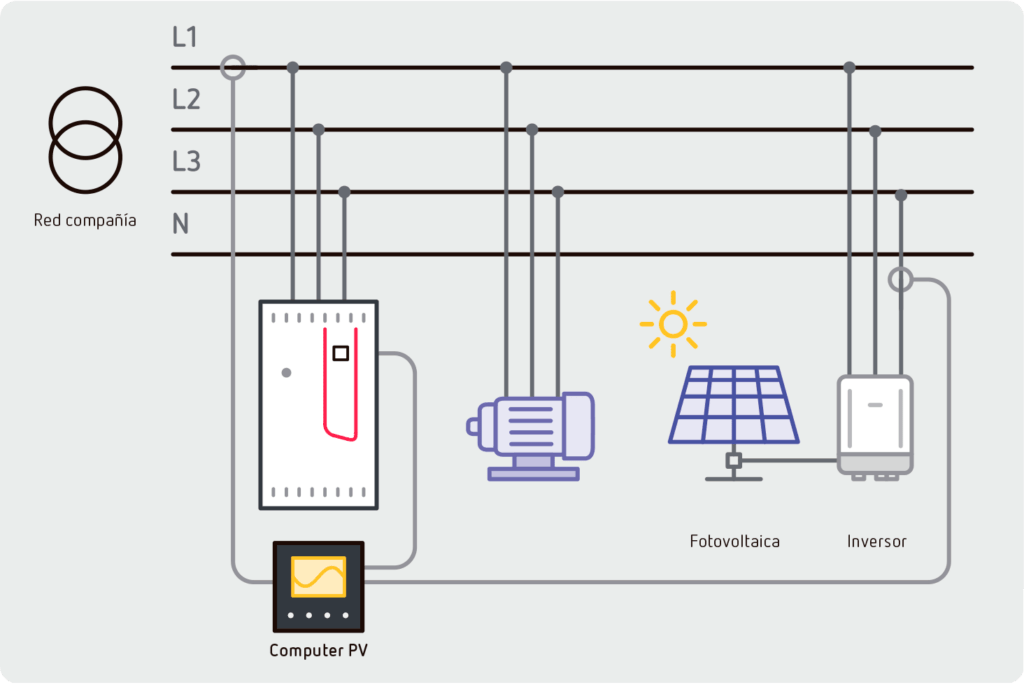
This device is designed for installations where different energy sources coexist, such as consumption from the electricity grid, solar generation and even a third additional source.
Thanks to its three independent current inputs and its internal software summation logic, the Computer PV 12 regulator provides a more precise measurement of the installation's true behaviour.
In this way, the need to install current external current summators is eliminated, simplifying the installation and improving accuracy in calculating the cos φ.
The incorporation of photovoltaic self-consumption systems reduces the active energy demanded from the grid, but it does not necessarily eliminate the need to compensate for reactive energy.
This situation can cause capacitor banks to stop regulating correctly if the regulator does not adequately interpret the installation's overall energy flows.
Until now, correcting this problem could require installing additional summing current transformers. Its function was to transmit the installation's total consumption to the existing regulator, that is, the sum of grid consumption and photovoltaic generation.
The Computer PV 12 resolves this situation in a simpler way. The device integrates the measurement of multiple energy sources through independent current inputs and internally performs the summation of the signals.
Thus, the regulator obtains a more precise measurement of the installation's true electrical behaviour and allows for a more efficient regulation of the capacitor bank.
As a result, the capacitor bank can operate correctly in installations with photovoltaic self-consumption, reducing regulation errors, avoiding overcompensations and minimising the risk of reactive energy penalties.
One of the key advantages of the Computer PV 12 is its capability to operate in all four quadrants. This allows it to regulate correctly both in consumption situations and in energy generation or export scenarios.
This functionality is especially important in installations with photovoltaic self-consumption, where energy flows are increasingly variable.
During certain hours of the day, the installation can consume energy from the grid. At other times, photovoltaic generation can significantly reduce this consumption or even generate a surplus.
In this context, having a reactive energy regulator capable of interpreting different consumption and generation scenarios is essential to maintain precise, stable compensation that is adapted to the reality of the installation.
To ensure correct operation, all current measurements must always be taken on the same phase.
If the measurements are taken on different phases, reading errors and inadequate compensation regulation can occur. This can cause discrepancies between the values recorded by the regulator and the values measured by the utility's meter.
For this reason, the correct installation and configuration of the measurement system is key to ensuring that the capacitor bank operates efficiently and in line with the true behaviour of the installation.
In some installations, even after installing a Computer PV 12 reactive energy regulator and correctly adjusting the current measurement, discrepancies may still exist between the power factor recorded by the regulator and that measured by the utility's meter.
As a consequence, it is possible to continue receiving reactive energy penalties even if the capacitor bank is working correctly.
This can occur when there is a large difference between consumption from the grid and photovoltaic generation, or when compensation accuracy is limited by the step size of the capacitor bank.
In these cases, the cos φ can remain at penalisable values, since a conventional capacitor bank regulates in steps and cannot always adjust the compensation with the necessary precision.
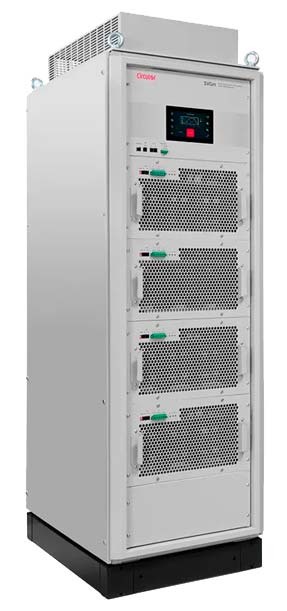
To resolve this problem, it is necessary to use an SVGm static var generator. This device, based on power electronics, allows for continuous and precise compensation, adjusting the reactive power kvar by kvar.
In this way, the SVGm allows the remaining compensation to be corrected and avoids penalties that cannot be resolved solely with a conventional capacitor bank.
The Computer PV 12 is the recommended solution for installations with photovoltaic self-consumption where a precise measurement of the entire installation and efficient regulation of the capacitor bank are required.
It is especially useful in installations with a cos φ equal to or close to 1, or in those where various energy sources coexist and it is necessary to avoid measurement errors caused by photovoltaic generation.
However, when the capacitor bank cannot adjust the compensation with the necessary precision, or when penalties continue to appear despite correct regulation, the SVGm becomes the appropriate solution.
The main difference is that the Computer PV 12 improves the measurement and regulation of the capacitor bank, while the SVGm allows for dynamic, continuous and highly precise compensation.
Photovoltaic self-consumption changes the way an installation consumes, generates and compensates for energy. Therefore, traditional regulation systems may not be sufficient to avoid reactive energy penalties in all scenarios.
The Computer PV 12 makes it possible to adapt power factor correction to installations with self-consumption by measuring different energy sources and more accurately calculating the installation's true cos φ.
In those installations where even more precise compensation is required, the SVGm makes it possible to adjust reactive power continuously to avoid penalties and improve the system's energy efficiency.
With these solutions, Circutor helps industrial and commercial installations maintain more precise and stable power factor correction adapted to the new challenges of photovoltaic self-consumption.
Why do reactive energy penalties occur in installations with photovoltaic self-consumption?
Because photovoltaic self-consumption reduces the active energy consumed from the grid, but the demand for reactive energy can remain the same. This can alter the power factor recorded by the utility's meter and generate reactive energy penalties that did not previously exist.
How does photovoltaic self-consumption affect a capacitor bank?
Self-consumption can modify the way the capacitor bank interprets the installation's real consumption. If the regulator does not correctly measure grid energy and photovoltaic generation, the power factor correction can be imprecise.
What role does the Computer PV 12 play in power factor correction?
The Computer PV 12 makes it possible to measure different energy sources through three independent current inputs. Thus, the regulator calculates the installation's true cos φ more accurately and improves the regulation of the capacitor bank.
Does the Computer PV 12 always avoid reactive energy penalties?
The Computer PV 12 helps to optimise power factor correction in installations with photovoltaic self-consumption. However, if the capacitor bank cannot adjust the compensation with sufficient precision, it may be necessary to install an SVGm.
When is it necessary to install an SVGm in photovoltaic self-consumption?
An SVGm may be necessary when there are significant differences between grid consumption and photovoltaic generation, or when the capacitor bank cannot compensate with the necessary precision. The SVGm adjusts the reactive power kvar by kvar to avoid penalties.

WRITTEN BY CIRCUTOR
Vial Sant Jordi s/n – 08232
Viladecavalls, Barcelona (Spain)
+34 93 745 29 00
Contact
After-Sales and Technical Assistance
+34 93 745 29 19
Send enquiry

© 2026 CIRCUTOR.COM | All rights reserved.